The FIFA World Cup is the most prestigious and widely watched football tournament in the world. Organized by FIFA, it brings together the best national teams from across the globe every four years. What began as a small international competition in 1930 has grown into one of the largest sporting events on Earth, attracting billions of viewers.
How Did the World Cup Begin?
In the early 20th century, international football was mainly played at the Olympic Games. However, FIFA President Jules Rimet believed that football deserved its own global championship. In 1928, FIFA officially decided to create a standalone international tournament that would determine the world’s best national team.
This decision led to the birth of the FIFA World Cup, with the first edition scheduled for 1930.
The First World Cup – Uruguay 1930
The inaugural FIFA World Cup was held in Uruguay from July 13 to July 30, 1930. Only 13 teams participated, as travel between Europe and South America was expensive and time-consuming. There was no qualification process; participating nations were invited directly by FIFA.
The final took place at the iconic Estadio Centenario in Montevideo, where Uruguay defeated Argentina 4–2 to become the first World Cup champion in history.
Growth of the Tournament
The second World Cup was hosted by Italy in 1934, and Italy successfully defended its title in 1938, becoming the first nation to win back-to-back championships.
The tournament was suspended during World War II, meaning the 1942 and 1946 World Cups were never played. The competition returned in 1950 in Brazil, where Uruguay stunned the host nation in one of football’s greatest upsets. The match became known as the famous “Maracanazo.”
The Golden Era of World Football
The 1958 World Cup introduced the world to a 17-year-old Pelé, who helped Brazil win its first title. Brazil soon became football’s most successful nation, winning a record five World Cups.
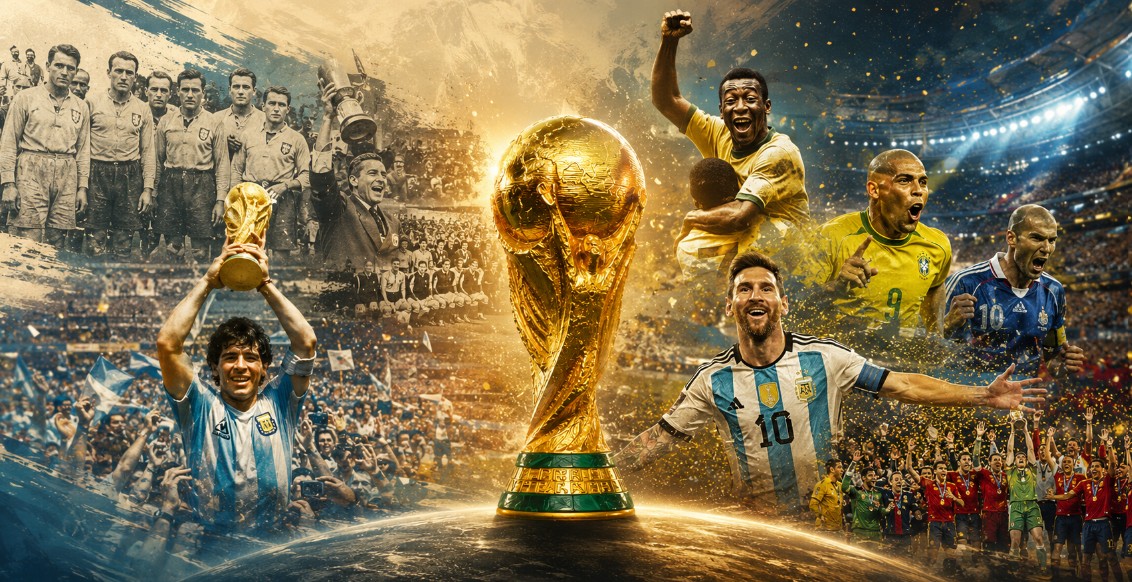
Over the decades, the tournament showcased legendary players such as Pelé, Diego Maradona, Zinedine Zidane, Ronaldo Nazário, Lionel Messi, and Cristiano Ronaldo, turning the World Cup into football’s greatest stage.
FIFA World Cup Winners (1930–2022)
| Year | Host Country | Champion |
|---|---|---|
| 1930 | Uruguay | Uruguay |
| 1934 | Italy | Italy |
| 1938 | France | Italy |
| 1950 | Brazil | Uruguay |
| 1954 | Switzerland | West Germany |
| 1958 | Sweden | Brazil |
| 1962 | Chile | Brazil |
| 1966 | England | England |
| 1970 | Mexico | Brazil |
| 1974 | West Germany | West Germany |
| 1978 | Argentina | Argentina |
| 1982 | Spain | Italy |
| 1986 | Mexico | Argentina |
| 1990 | Italy | West Germany |
| 1994 | United States | Brazil |
| 1998 | France | France |
| 2002 | South Korea / Japan | Brazil |
| 2006 | Germany | Italy |
| 2010 | South Africa | Spain |
| 2014 | Brazil | Germany |
| 2018 | Russia | France |
| 2022 | Qatar | Argentina |
Most Successful Nations
| Country | Titles |
|---|---|
| Brazil | 5 |
| Germany | 4 |
| Italy | 4 |
| Argentina | 3 |
| France | 2 |
| Uruguay | 2 |
| England | 1 |
| Spain | 1 |
Brazil remains the most successful nation in World Cup history, having won the trophy five times.
Interesting Facts About the World Cup
- The first World Cup in 1930 featured only 13 teams.
- Brazil is the only nation to have participated in every World Cup tournament.
- The original World Cup trophy was called the Victory Trophy and was later renamed the Jules Rimet Trophy.
- The 2002 World Cup was the first tournament jointly hosted by two countries: South Korea and Japan.
- The 2022 FIFA World Cup in Qatar became one of the most-watched sporting events in history, reaching billions of viewers worldwide.
- Only eight nations have won the World Cup since the competition began in 1930.
Conclusion
From its humble beginnings in Uruguay in 1930 to becoming the world’s biggest sporting spectacle, the FIFA World Cup has played a central role in the history of football. It has united fans across continents, created unforgettable moments, and crowned some of the greatest teams and players the sport has ever seen. Today, the World Cup remains the ultimate dream for every footballer and one of the most celebrated events in global sports. ⚽🌍
Published on February 6, 2026 · Last updated on February 6, 2026