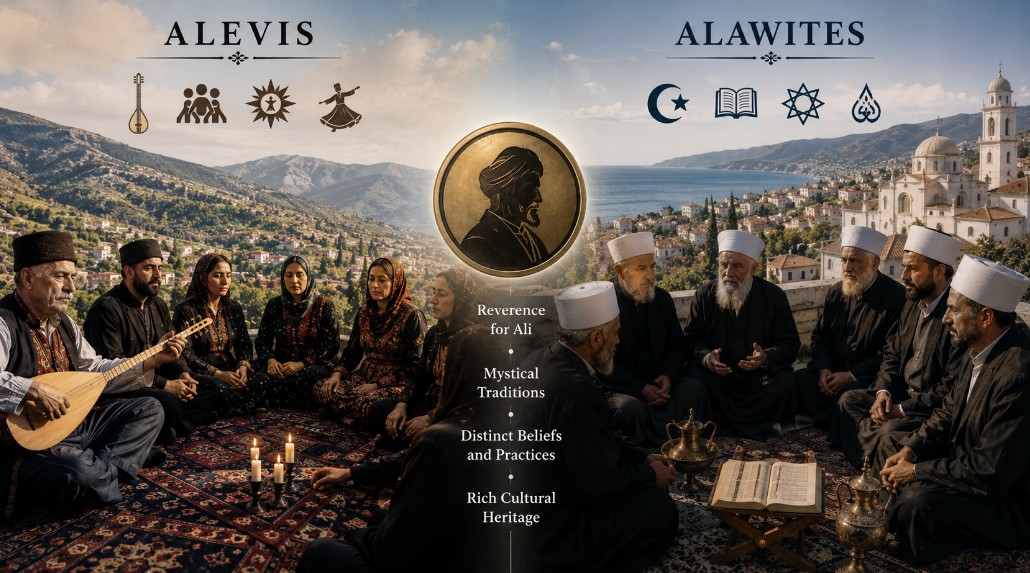
Alevis and Alawites are two distinct religious communities of the Middle East whose names sound similar and whose traditions both involve a special reverence for Ali ibn Abi Talib, the cousin and son-in-law of the Prophet Muhammad. Because of this connection, they are often confused with one another. In reality, however, they differ significantly in their history, theology, culture, and religious practices.
The term “Alevi” is primarily used for a religious community found in Turkey. Most Alevis are Turkish-speaking, although there are also Kurdish Alevis. Their tradition developed over centuries through a combination of Shi’a influences, Sufi mysticism, and local Anatolian religious customs.
The term “Alawite” refers mainly to a religious group concentrated in Syria, with smaller communities in Lebanon and Turkey. Historically, they were known as Nusayris and developed as a distinct branch of Shi’a Islam with unique theological beliefs.
Both Alevis and Alawites hold Ali ibn Abi Talib in exceptionally high regard. This shared devotion is one of the main reasons people often assume they belong to the same tradition.
For Alevis, Ali represents spiritual perfection, justice, wisdom, and closeness to God. Their understanding of Ali is deeply influenced by mystical and Sufi interpretations of Islam.
Among Alawites, Ali occupies an even more central theological position. Historically, some Alawite teachings attributed to him a semi-divine or divine status, setting their beliefs apart from both Sunni Islam and mainstream Shi’a traditions.
Alevi religious life centers on communal gatherings known as “Cem” ceremonies. Unlike most Muslim traditions, these ceremonies are not usually held in mosques but in special assembly houses or community spaces.
Music plays a vital role in Alevi worship. A traditional stringed instrument called the saz accompanies religious hymns and poetry, making music an essential part of their spiritual expression.
Alawite religious practices are generally more private and esoteric. For centuries, many aspects of their theology and rituals were transmitted only to initiated members of the community.
Alevis generally do not observe the five daily prayers in the same manner as Sunni Muslims. Instead, they place greater emphasis on inner spirituality, ethical conduct, and personal development.
Gender equality is another notable characteristic of Alevi communities. Men and women often participate together in religious ceremonies, a practice that differs from the traditions of many Muslim societies.
Alawite beliefs contain elements that scholars have compared not only to Shi’a Islam but also to various mystical, philosophical, and religious traditions, including aspects of Christianity and Gnosticism.
Most Alevis consider themselves Muslims, although their beliefs and practices differ considerably from both Sunni and mainstream Shi’a Islam. Some researchers even describe Alevism as a distinct religious tradition.
The political significance of the Alawite community increased dramatically in modern Syria. The ruling Assad family belongs to the Alawite community, giving Alawites an important role in the country’s political and military institutions.
Historically, both Alevis and Alawites have experienced discrimination and persecution. As minority groups living among larger Sunni Muslim populations, they often faced social and political pressures.
Despite these challenges, Alevis preserved a rich cultural heritage in Turkey. Their music, poetry, oral traditions, and religious customs remain an important part of Anatolia’s cultural landscape.
Alawites likewise maintained their distinct identity for centuries, particularly in the mountainous coastal regions of Syria. Geographic isolation helped preserve many of their traditions and beliefs.
Both communities share a strong mystical dimension. They emphasize the inner meaning of faith and spiritual understanding rather than strict adherence to external religious rituals.
Nevertheless, Alevis and Alawites are not the same. They emerged from different historical backgrounds, developed different theological systems, and practice their faith in different ways. Their most important similarity is their reverence for Ali, while their greatest differences lie in how they understand his role and express their religious beliefs.
Today, the global Alevi population is estimated at roughly 15–25 million people, primarily in Turkey and the Turkish diaspora. The Alawite population is much smaller, estimated at around 2–4 million, mostly concentrated in Syria. Despite the similarity of their names, Alevis and Alawites remain two distinct and unique traditions within the diverse religious landscape of the Middle East.