Introduction
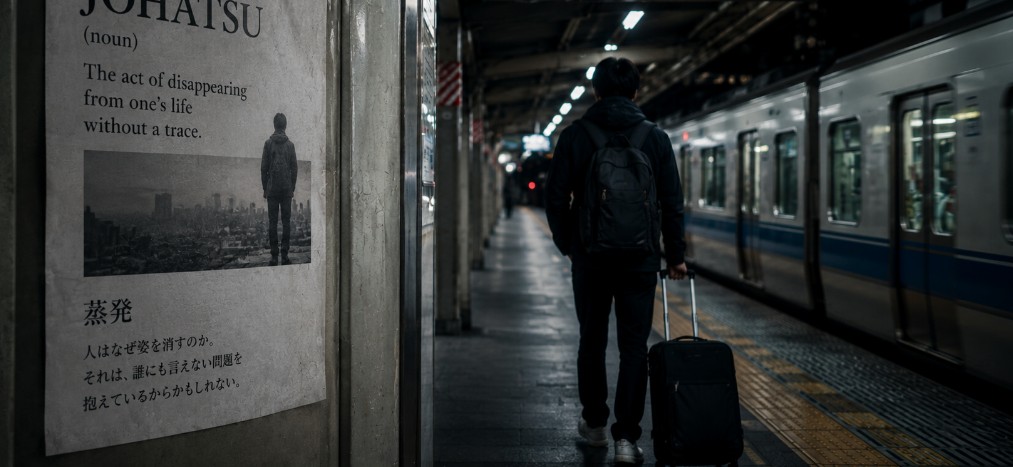
Japan is home to a unique social phenomenon known as Jōhatsu (蒸発), a word that literally means “evaporation.” In a social context, however, it refers to people who voluntarily disappear from their existing lives, cutting ties with family, friends, employers, and communities. They vanish so completely that it often seems as if they have evaporated into thin air.
Unlike missing persons who disappear due to crime or accidents, Jōhatsu individuals make a conscious decision to leave their old lives behind. Their motivations vary, but many are driven by financial troubles, personal failures, family conflicts, or overwhelming social pressure.
The phenomenon has fascinated sociologists, journalists, and filmmakers for decades because it reveals hidden aspects of Japanese society that are rarely discussed openly.
The Meaning Behind the Term
The Japanese word “Jōhatsu” combines the characters for steam and disappearance. It was originally used in a literal sense to describe evaporation, but over time it became a metaphor for people who seemingly vanish without a trace.
The term gained popularity during Japan’s economic boom of the 1960s and 1970s. As expectations for professional success and social conformity increased, some individuals found themselves unable to cope with the pressure.
Rather than facing public embarrassment or disappointment, they chose to disappear and start over elsewhere.
Why Do People Become Jōhatsu?
There is no single reason why someone chooses to disappear. In most cases, the decision results from a combination of personal and social factors.
Financial problems are among the most common causes. Individuals burdened by debt may feel trapped and see disappearance as their only escape.
Family conflicts can also play a significant role. Divorce, domestic disputes, abusive relationships, and strained family dynamics sometimes push people toward abandoning their previous lives.
Career failure is another major factor. In Japan, professional identity often carries enormous importance. Losing a job, failing an exam, or disappointing an employer can create a deep sense of shame.
Mental health struggles, including depression and anxiety, may further contribute to the desire to withdraw completely from society.
The Role of Shame in Japanese Society
Many experts believe that the Jōhatsu phenomenon cannot be fully understood without considering Japan’s cultural attitudes toward shame and social responsibility.
Japanese society traditionally places great value on harmony, duty, and reputation. People are often expected to fulfill their obligations not only for themselves but also for their families, workplaces, and communities.
When someone experiences failure, they may feel they have let down everyone around them.
As a result, some individuals view disappearance as a way to avoid burdening others or bringing embarrassment to those connected to them.
This cultural context helps explain why Jōhatsu occurs more frequently in Japan than in many other countries.
Night Moving Companies
One of the most unusual aspects of the phenomenon is the existence of specialized moving services often called “night movers.”
These companies assist clients who wish to relocate secretly and quickly.
A typical operation may take place late at night when neighbors are asleep. Workers quietly pack belongings, transport them to a new location, and help clients establish a fresh start.
The companies emphasize confidentiality and discretion, ensuring that former spouses, creditors, employers, or family members cannot easily trace the person’s new address.
For some Jōhatsu individuals, these services are essential for disappearing successfully.
Life After Disappearance
Disappearing does not necessarily mean living a glamorous new life.
Many Jōhatsu individuals relocate to large cities where anonymity is easier to maintain. Tokyo, Osaka, and Yokohama offer opportunities to blend into enormous populations.
They often accept temporary or low-paying jobs that require minimal background checks.
Some live in inexpensive apartments, internet cafés, or boarding houses while rebuilding their lives.
Because maintaining secrecy is important, many avoid discussing their past and limit social connections.
Anonymous Neighborhoods
Certain districts in Japan have become known as places where people can disappear more easily.
These areas typically offer cheap housing, temporary employment, and limited scrutiny from authorities or neighbors.
Historically, neighborhoods such as San’ya in Tokyo and Kamagasaki in Osaka have attracted individuals seeking anonymity.
Many residents work day-labor jobs and maintain minimal ties to mainstream society.
Such districts have sometimes been described as “invisible communities” existing on the margins of modern Japan.
The Legal Perspective
In Japan, adults generally have the right to leave their homes and relocate without informing anyone.
If there is no evidence of a crime, police involvement is often limited.
This legal framework makes it difficult for family members to locate someone who has intentionally disappeared.
While authorities may investigate suspicious circumstances, they also respect an individual’s right to privacy and freedom of movement.
As a result, many Jōhatsu cases remain unresolved for years.
The Impact on Families
For those left behind, the disappearance of a loved one can be emotionally devastating.
Families often experience years of uncertainty, not knowing whether the missing person is safe, alive, or even still in the country.
Unlike death, disappearance offers no closure.
Parents may continue searching for decades. Spouses may struggle to move forward without answers. Children may grow up wondering why a parent vanished.
The psychological burden of uncertainty can be immense.
The Media’s Fascination
The mystery surrounding Jōhatsu has attracted significant media attention both inside and outside Japan.
Numerous books, documentaries, and investigative reports have explored the stories of people who chose to disappear.
Many journalists have attempted to understand what drives ordinary individuals to abandon everything they know.
These stories often reveal complex personal struggles rather than simple acts of escape.
Jōhatsu in the Digital Age
Modern technology has made disappearing more difficult than ever before.
Smartphones, surveillance cameras, digital payments, social media platforms, and online records create extensive trails of personal information.
Even so, some people still manage to vanish by avoiding digital services and limiting their interactions with official systems.
Their success demonstrates that complete anonymity, while increasingly difficult, is not impossible.
Economic Pressures and Disappearance
Economic instability has long been linked to the Jōhatsu phenomenon.
Periods of recession, unemployment, and rising debt have historically coincided with increases in voluntary disappearances.
People facing financial collapse may fear public humiliation more than economic hardship itself.
For some, starting over in another city appears preferable to confronting creditors, employers, or disappointed relatives.
Psychological Dimensions
Psychologists often view Jōhatsu as an extreme coping mechanism.
When individuals feel overwhelmed by stress, shame, or failure, they may perceive disappearance as a means of regaining control over their lives.
Rather than solving underlying problems, however, disappearing frequently creates new challenges, including loneliness, isolation, and economic insecurity.
The decision may provide temporary relief, but it rarely eliminates emotional pain completely.
Gender and Jōhatsu
Both men and women become Jōhatsu, although their reasons may differ.
Men have historically been more likely to disappear due to financial difficulties or career setbacks.
Women are more commonly associated with cases involving domestic abuse, harassment, or family conflicts.
In recent years, changing social norms have broadened the range of motivations across all demographics.
Changing Attitudes in Japan
Younger generations in Japan are increasingly open about discussing mental health, personal struggles, and emotional well-being.
Counseling services and support networks have become more accessible than in previous decades.
As a result, some researchers believe the social conditions that contribute to Jōhatsu may gradually weaken over time.
Nevertheless, economic stress and societal expectations continue to affect millions of people.
Cultural Significance
Jōhatsu is more than a story about missing individuals.
It reflects broader themes within Japanese culture, including social obligation, personal identity, shame, and the desire for belonging.
The phenomenon illustrates how deeply societal expectations can influence personal decisions.
It also raises important questions about the balance between individual freedom and social responsibility.
Lessons for the Modern World
Although Jōhatsu is most strongly associated with Japan, the underlying issues are universal.
People everywhere experience financial pressure, emotional distress, family conflict, and fear of failure.
The phenomenon reminds us that behind every disappearance is a human story shaped by circumstances, choices, and hopes for a better future.
Understanding Jōhatsu encourages greater compassion toward those who struggle silently.
Conclusion
Jōhatsu remains one of Japan’s most intriguing and mysterious social phenomena. Every year, thousands of individuals leave their former lives behind and attempt to begin again elsewhere.
Some disappear to escape debt, others to avoid shame, and some simply to seek a fresh start free from the burdens of the past.
While their stories differ, they share a common desire: the hope that somewhere beyond the pressures of their old lives, a new beginning is possible.
The phenomenon serves as a powerful reminder of how social expectations, personal struggles, and cultural values can shape the choices people make—and how, sometimes, those choices lead them to simply disappear.