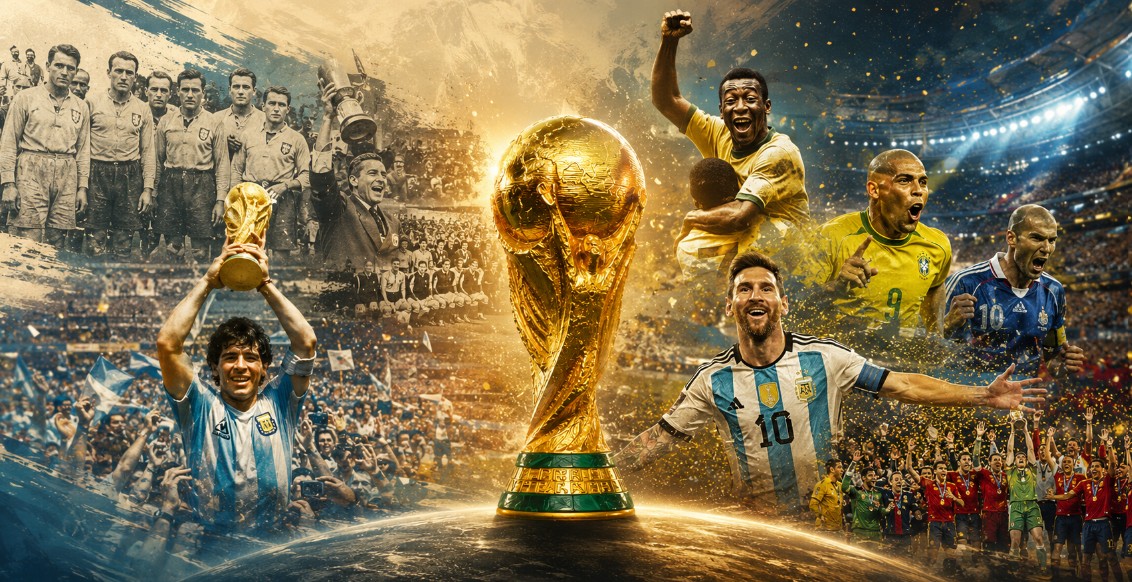
More than just a football tournament, the FIFA World Cup is a quadrennial global carnival, a unifying spectacle that captures the hearts of billions. Since its inception, it has woven a rich tapestry of heroic triumphs, heartbreaking defeats, and unforgettable moments, cementing its place as the pinnacle of international sport. Each championship tells a story, contributing to the legend of the beautiful game.
The Genesis: The First Kings (1930s)
The idea of a global football championship had been brewing for years, spearheaded by FIFA President Jules Rimet. It finally came to fruition in 1930, hosted and won by Uruguay on home soil, defeating Argentina in the final. This inaugural tournament set the stage for a legacy that would span generations.
The next two editions saw the rise of a European powerhouse: Italy. Under Vittorio Pozzo, they claimed back-to-back titles in 1934 (as hosts) and 1938, becoming the first nation to successfully defend the trophy and showcasing a formidable blend of tactical discipline and individual flair. The outbreak of World War II then halted the competition, leaving football in hiatus for over a decade.
The Post-War Renaissance & Brazilian Brilliance (1950s-1970s)
The World Cup returned in 1950 with the infamous “Maracanazo,” where Uruguay stunned hosts Brazil in their own colossal stadium to claim their second title. The 1954 tournament saw the “Miracle of Bern,” as a resilient West Germany overcame the seemingly invincible Hungarian “Magical Magyars” in a shocking upset.
But the late 1950s and 1960s belonged to one nation: Brazil. Ushering in an era of attacking, beautiful football (“Joga Bonito”), they captured their first title in 1958 with a young Pelé announcing himself to the world. They successfully defended their crown in 1962, and then, with perhaps the greatest team ever assembled, secured their third title in 1970, permanently taking possession of the original Jules Rimet trophy. Brazil’s dominance fundamentally changed how the game was played and perceived.
Amidst Brazil’s reign, England finally lifted the trophy on home soil in 1966, their sole triumph, in a memorable final against West Germany. The 1970s saw new winners: West Germany claimed their second title in 1974 on home turf, led by Franz Beckenbauer, and Argentina, inspired by Mario Kempes, won their first in 1978 as hosts, amidst a fervent atmosphere.
Maradona, German Efficiency & French Flair (1980s-1990s)
The 1980s were largely defined by individual brilliance. In 1982, Italy, spearheaded by Paolo Rossi, defied expectations to win their third World Cup. But the 1986 tournament was the “Diego Maradona show.” Almost single-handedly, Maradona dragged Argentina to their second title with a series of sublime and controversial performances.
The final of 1990 saw West Germany exact revenge on Argentina, claiming their third title in a pragmatic affair, marking the last time a unified German team would win until 2014. Brazil returned to the summit in 1994, winning a record fourth title after a tense penalty shootout against Italy. The decade culminated in a historic moment in 1998 when hosts France, led by Zinedine Zidane, defeated Brazil to win their first-ever World Cup, sparking nationwide jubilation.
The Globalized Game & New Dynasties (2000s-Present)
The new millennium continued to deliver thrilling football. Brazil won an unprecedented fifth title in 2002, with the formidable attacking trio of Ronaldo, Rivaldo, and Ronaldinho leading the charge. Italy secured their fourth title in 2006 after a dramatic final against France that ended in a penalty shootout.
The 2010 tournament in South Africa saw a new champion emerge: Spain. Their “tiki-taka” style of possession-based football revolutionized the game, and they claimed their maiden title after an extra-time winner against the Netherlands. Germany, now unified and playing a modern, efficient brand of football, lifted their fourth trophy in 2014 in Brazil, dismantling the hosts in a historic semi-final.
France added a second star to their jersey in 2018, showcasing a blend of youthful exuberance and tactical solidity to defeat Croatia in a high-scoring final. And most recently, in a truly memorable 2022 final, Argentina, led by the legendary Lionel Messi in his crowning moment, defeated France in a thrilling penalty shootout to secure their third World Cup title, bringing an emotional end to one of football’s greatest narratives.
The Enduring Legacy
The FIFA World Cup has crowned just eight distinct nations as champions over its 22 editions: Brazil (5), Germany (4), Italy (4), Argentina (3), Uruguay (2), France (2), England (1), and Spain (1). Each victory is etched in the annals of sporting history, representing years of dedication, moments of genius, and the sheer will to win.
Beyond the trophies and medals, the World Cup championship history is a testament to the sport’s power to unite, inspire, and captivate. It’s a living, breathing story, constantly evolving, promising new heroes, new moments, and new legends with every passing four years. The golden tapestry continues to grow, richer and more vibrant with each triumphant roar.