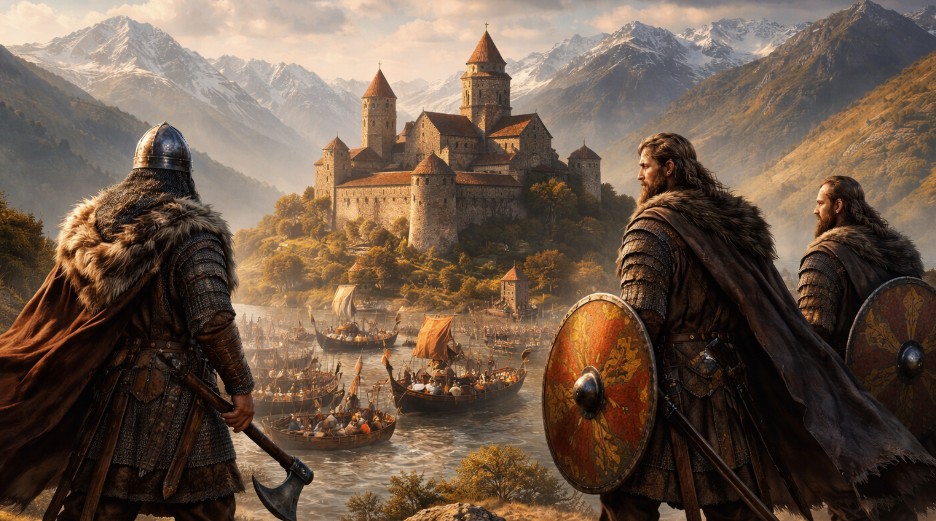
The Vikings, originating from Scandinavia, are among the most iconic seafarers and warriors in world history. Active primarily between the 8th and 11th centuries, they are often remembered for their raids along the coasts of Europe, the British Isles, and even as far west as North America. However, the Vikings were not only raiders—they were also traders, explorers, and mercenaries. Their vast networks of trade and military expeditions extended far beyond Scandinavia, reaching regions in Eastern Europe, the Middle East, and potentially even the Caucasus, including modern-day Georgia.
Viking Expansion and Trade Routes
The Vikings’ influence was largely facilitated by their impressive navigational skills and ability to travel long distances by river and sea. In Eastern Europe, they used major rivers such as the Dnieper, Volga, and Don to reach the Black Sea and the Caspian Sea. These routes connected them with powerful states of the time, including the Byzantine Empire, the Khazar Khaganate, and the Arab Caliphates.
Georgia, strategically located at the crossroads of Europe and Asia, became an indirect part of these expansive networks. While there is no evidence of permanent Viking settlements in Georgian lands, trade likely brought Scandinavian merchants into contact with local populations. Archaeological findings in the Caucasus region—including northern-style weaponry, jewelry, and coins—suggest that goods, ideas, and even people from Viking territories may have reached Georgia. Likewise, Georgian products such as wine, honey, and fine textiles could have traveled northward through these trade routes.
The Vikings as Mercenaries
In addition to trade, the Vikings frequently served as mercenaries in foreign armies. One of the most notable examples is the Varangian Guard, an elite unit in the Byzantine Empire composed mainly of Scandinavian warriors. Their reputation for loyalty and military prowess made them highly valued in Byzantium, which had extensive contacts with the Caucasus region. Historical accounts indicate that some of these warriors could have passed through Georgian territories, either on campaigns or while serving Byzantine rulers. Their presence may have also influenced local military tactics, weaponry, and even aspects of aristocratic culture in the region.
Cultural and Archaeological Connections
Although direct evidence of Viking settlements or cultural domination in Georgia is scarce, subtle traces of interaction exist. Scandinavian-style swords, axes, and personal adornments have been discovered in some areas of the Caucasus, hinting at the exchange of goods and techniques. These artifacts demonstrate not only the reach of Viking trade but also the appreciation and integration of foreign craftsmanship into local Georgian culture. Moreover, the Vikings’ journeys contributed to the flow of ideas, technologies, and practices across continents, meaning Georgia indirectly participated in a broader Eurasian exchange network during the medieval period.
Georgia’s Role in Medieval Trade
During the early Middle Ages, Georgia was a key hub on the Silk Road, connecting Europe and Asia. Its fertile lands, wine production, and mineral resources attracted merchants from various regions. While the Vikings themselves may not have been permanent residents, the trading networks they helped establish would have intersected with Georgian commerce. It is possible that Viking merchants, along with Arab, Persian, and Byzantine traders, interacted with Georgian markets and ports, contributing to the cosmopolitan character of medieval Georgian cities.
Legacy and Historical Significance
Though Georgia was not a central focus of Viking exploration or conquest, the region’s connections to the wider Eurasian world suggest a subtle but significant influence. Through trade, mercenary activity, and the movement of goods and ideas, Georgia was indirectly touched by the Vikings’ presence. While direct cultural or societal changes may not be evident, the very existence of Viking artifacts and the historical records of their travels show that Georgia was part of a world connected by exploration, commerce, and mobility long before the modern era.
The story of Vikings and Georgia illustrates the far-reaching impact of these Scandinavian warriors, traders, and explorers. It reminds us that medieval Europe and the Caucasus were part of interconnected networks where distant cultures could intersect in unexpected ways. Even without large-scale settlements or battles, Georgia’s involvement in Viking trade routes and military campaigns highlights the complex and interconnected nature of the medieval world.
Sources
- Vikings in Georgia: History or Myth? – This article explores the historical evidence and sagas regarding possible Viking travels toward Georgia and their indirect influence in the Caucasus. Read more
- Varangian Guard – Wikipedia – Overview of the elite Viking mercenary unit in Byzantium, providing context for Viking movements in the Caucasus region. Read more
- Vikings and Varangians in the Caucasus (XI century) – Scholarly article discussing Viking trade routes and references in medieval Georgian and Armenian chronicles. Read more