The Origin of Plants and Their Lasting Impact on Earth
Long before the age of dinosaurs, Earth was a vastly different place. Roughly 500 million years ago, the land was mostly barren, covered with rock and dry soil. There were no forests, grasses, or flowering plants, and life was largely confined to the oceans.
A major turning point in Earth’s history occurred when plants first began to colonize land. This transformation reshaped the planet in profound ways, laying the foundation for the ecosystems that exist today. The study of how plant and animal life has changed over time reveals just how significant this transition was.
Early Life Began in Water

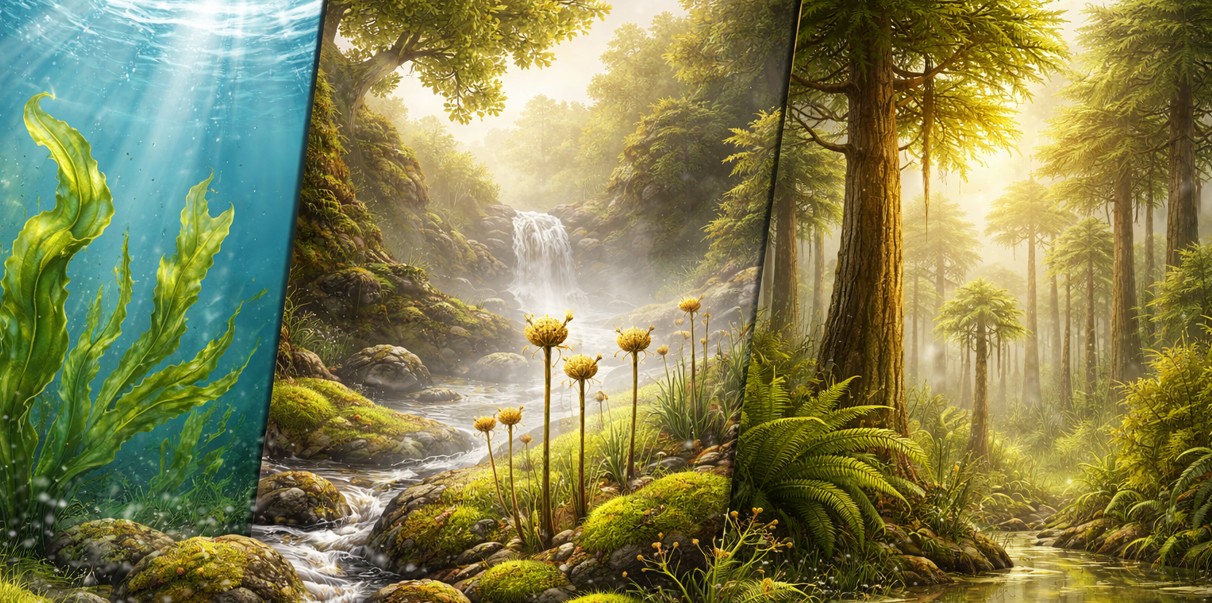
The origins of plant life trace back to aquatic environments. The earliest plant-like organisms were simple green forms such as algae, which are still visible today along coastlines or in freshwater habitats.
For over a billion years, algae thrived in oceans and lakes. These organisms are capable of producing their own food through photosynthesis, a process that uses sunlight, water, and carbon dioxide to generate energy-rich sugars. A crucial byproduct of this process is oxygen.
In the early stages of Earth’s history, the atmosphere contained very little oxygen. Over long periods, photosynthetic organisms gradually released oxygen into the air. This shift, often referred to as the Great Oxygenation Event, allowed more complex forms of life to develop. Without this increase in oxygen, animals—including humans—would not have been able to exist.
It is widely believed that true land plants evolved from green algae approximately 470 million years ago. These early forms lived in shallow waters near shorelines, where they were alternately submerged and exposed to air. Such conditions encouraged gradual adaptation to life outside water.
The Challenge of Moving onto Land

Transitioning from water to land presented serious challenges. Aquatic plants relied on water for support and nutrient absorption, but life on land required entirely new survival strategies.
To cope with these conditions, early plants developed several key adaptations. One of the most important was a protective waxy layer, known as the cuticle, which reduced water loss. Structural strength also improved through stronger cell walls, allowing plants to stand upright. In addition, primitive root-like structures called rhizoids helped anchor plants and absorb water and nutrients from the soil.
The earliest land plants were small and simple, resembling modern mosses, liverworts, and hornworts. These species typically grew in moist environments and remained close to the ground. Fossil evidence, including plants like Cooksonia, shows that early land vegetation consisted of tiny branching stems only a few centimeters tall.
Despite their size, these plants played a crucial role in shaping Earth. Their growth contributed to the breakdown of rocks into soil through a process known as weathering. This led to the formation of richer soils capable of supporting more complex life forms.
Additionally, the spread of plants increased oxygen levels in the atmosphere and created new habitats and food sources. This made it possible for various organisms, including early insects, to transition from aquatic to terrestrial environments.
The Rise of More Complex Plant Life

As plants became established on land, evolutionary developments continued. Around 420 million years ago, plants evolved vascular tissue—specialized structures that transport water and nutrients throughout the organism. This advancement allowed plants to grow taller and develop stronger structures.
Early vascular plants included ancestors of ferns and club mosses. With improved internal transport systems, plant life expanded rapidly. By approximately 360 million years ago, large forests covered much of the planet. These environments were dominated by towering plants, some reaching heights of over 30 meters.
Over time, the remains of these ancient forests were buried and compressed, eventually forming coal deposits. These fossil fuels are still used today as a source of energy.
The Emergence of Flowering Plants

A major evolutionary milestone occurred around 140 million years ago with the appearance of flowering plants, known as angiosperms. These plants introduced new reproductive strategies that significantly enhanced their ability to spread and diversify.
Flowers evolved to attract pollinators such as insects and birds, which helped transfer pollen between plants. Fruits developed to protect seeds and assist in their dispersal. Today, flowering plants dominate most terrestrial ecosystems, including trees, grasses, fruits, and vegetables.
How Plants Transformed the Planet
The emergence and evolution of plants fundamentally altered Earth’s environment. They enriched the atmosphere with oxygen, contributed to soil formation, and established ecosystems that enabled animals to thrive on land.
From simple aquatic organisms to complex flowering species, plants played a central role in turning Earth into a vibrant, life-supporting planet. Their influence continues to shape the natural world, making them essential to the diversity of life seen today.